Introducing ARGO – a modular, multi-color laser suite designed for advanced spectroscopy applications.
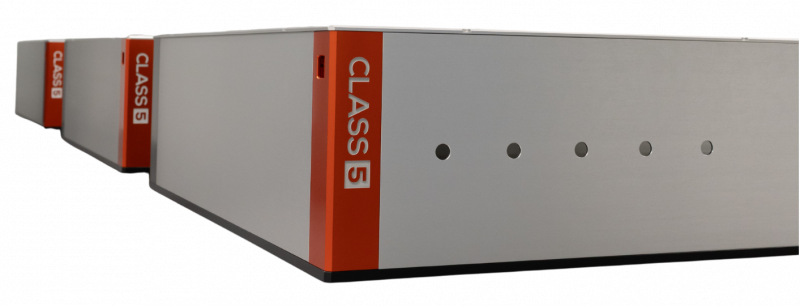
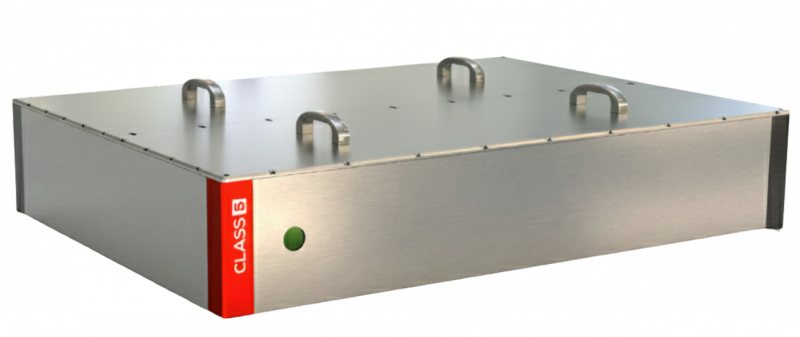
Class 5 proudly introduces ARGO: a high-power, widely tunable, multi-color femtosecond laser suite engineered for cutting-edge spectroscopy. Purpose-built to amplify and compress commercial Yb-based laser sources, ARGO achieves market-leading conversion efficiency while delivering fully compressed, ultrashort pulses with exceptional stability and performance.
ARGO integrates Class 5’s advanced optical parametric chirped-pulse amplification (OPCPA) technology, refined over more than a decade, with highly efficient nonlinear wavelength-conversion stages to deliver a wavelength coverage from the deep-UV (200 nm) to the mid-IR (16.2 µm). Combined with our advanced multipass cell (MPC) technology, ARGO achieves compression factors of up to 10× and pulse durations < 30 fs, while maintaining high optical throughput.
|
|
|
 |
 |
|
|
|
1. ARGO – an advanced modular laser suite
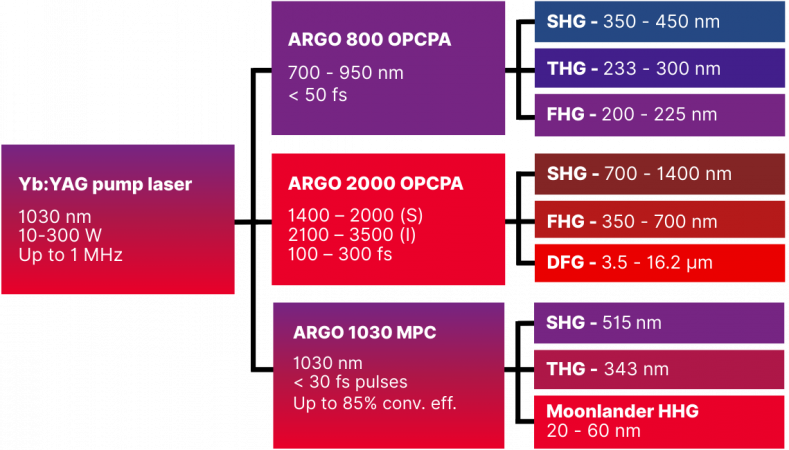
ARGO’s modular design enables flexible combinations of ARGO OPCPA and ARGO MPC units with conversion stages to build a high-power, tunable femtosecond laser suite for demanding pump-probe applications (Figure 1). Powered by the Class 5 Bridge, an IoT-enabled, modular control system, all outputs can be accessed, monitored and controlled seamlessly across your devices.
ARGO can be commissioned with a brand-new Yb-laser or seamlessly integrated with an existing source. The platform is compatible with a wide range of commercially available Yb-based light sources, including but not limited to:
- Monaco – Coherent
- A8000 – Amphos
- Carbide – Light Conversion
Please contact us to confirm compatibility with your specific laser source.
The modular architecture of ARGO empowers researchers with a reliable, powerful and versatile system precisely tailored to their applications.
2. ARGO in the hands of researchers
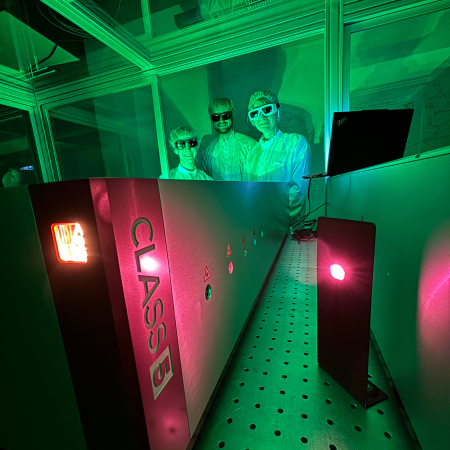
The first ARGO system has already been successfully installed as an ultrafast pump–probe laser system in the Light–Matter Interaction research group at the Center for Optical Technologies, Aalen University.
Operating at 100 kHz, the ARGO system delivered have a broad spectral coverage with industry-leading compressed conversion efficiencies. All capabilities are unified in a single platform, providing automated, synchronized ultrafast outputs from the UV to the mid-IR:
- ARGO 800: 700 – 950 nm + SHG at 350 – 450 nm (>13% conversion delivered)
- ARGO 2000: 1.8 – 2.4 µm (12% conversion delivered), and DFG 10–15 µm (0.8% conversion delivered)
- ARGO 1030 MPC: 1030 nm with 25 fs (95% conversion delivered) + SHG 515 nm and THG 343 nm
- Supercontinuum (aux.): 600–900 nm
- Mid-IR OPCPA output: 5 µm
The Class 5 Bridge platform enables virtually arbitrary pairing of these outputs, supporting parallel pump–probe operation and flexible spectral tuning. This versatility unlocks advanced research in nonlinear optics and materials science, including transient absorption spectroscopy, sonophotonics, photopolymerization, and laser-induced refractive-index modification.
 |
“I have 22 different ultrafast pump-probe modes configured. With this system, I have the flexibility to study ultrafast light matter interactions in various materials for the optics industry.”
— Anne Harth, Professor of Optical Engineering and Applied Photonics at the Faculty of Optics, Aalen University of Applied Sciences. |
3. What motivated Class 5 to develop ARGO
Since their commercialization in the early 1990s, mode-locked Ti:sapphire lasers have been foundational to ultrafast spectroscopy [1-2]. However, today’s most advanced ultrafast spectroscopy applications, including attosecond science, particle acceleration, multiphoton processes, micromachining, and coherent Raman techniques, demand laser sources that combine high peak power with repetition rates from tens of kilohertz to the megahertz regime. At these operating conditions, Ti:sapphire technology becomes impractical due to its large quantum defect, which leads to excessive heat generation and complex cooling requirements [2-3].
Yb-doped laser systems have emerged as a compelling alternative, offering excellent efficiency, high average power, and millijoule-level pulse energies [2-4]. Yet their intrinsically narrow gain bandwidth limits wavelength tunability, pulse duration, and temporal contrast, factors that are critical for many ultrafast experiments [2].
To overcome these limitations and empower researchers, Class 5 has leveraged its long-standing expertise in OPCPA technology to develop ARGO. By amplifying and converting the output of Yb-based lasers with market-leading conversion efficiency and enabling efficient pulse recompression, ARGO delivers ultrashort pulses across an exceptionally broad spectral range. The result is a powerful, reliable platform purpose-built for the most advanced ultrafast spectroscopy and light–matter interaction experiments.
References
- Nature Collection: Microscopic Imaging in Deep Tissue. 09 April 2024. https://www.nature.com/collections/hgaebhdjfg
- Xiao, Y. et al. Three-photon excited fluorescence imaging in neuroscience: From principles to applications. Front Neurosci. 17, 1085682 (2023). https://doi.org/10.3389/fnins.2023.1085682
- Weisenburger, S. et al. Volumetric Ca2+ imaging in the mouse brain using hybrid multiplexed sculpted light microscopy. Cell 177, 1050–1066 (2019). https://doi.org/10.1016/j.cell.2019.03.011
- Streich, L. et al. High-resolution structural and functional deep brain imaging using adaptive optics three-photon microscopy. Nature Methods, 18, pages 1253–1258 (2021). https://doi.org/10.1038/s41592-021-01257-6


