White Dwarf dual – dual channel lasers for multiphoton microscopy
Dual Channel Lasers for 2- and 3-photon volumetric- and deep-tissue imaging with red and green markers
- wavelength: 920 nm , 960 nm, 1300 nm and 1700 nm
- average power: > 3 W or > 5 W
- optimized for multicolor volumetric and deep imaging
- based on industrial Yb-fiber femtosecond laser
Introduction
High performance femtosecond laser for multiphoton microscopy (2p and 3p microscopy)
The White Dwarf is a femtosecond laser system specially designed for two and three-photon microscopy offering highest performance and robustness.
The White Dwarf is a compact and robust femtosecond laser system specially designed for 3-photon microscopy, offering now simultaneously 1300 and 1700 nm at outstanding performance parameters. With the highest peak power available for 3-photon microscopy, the White Dwarf allows neuroscientists to image deeper, faster and at better resolution than ever before at green and red fluorescent markers.
You are currently viewing a placeholder content from YouTube. To access the actual content, click the button below. Please note that doing so will share data with third-party providers.
Features
Optimized for multi-color imaging
Two simultaneous outputs at 1300 nm and 1700 nm or 960 nm or 920 nm
Ideal for deep imaging
> 5 W average power after compressor
Proven in the field
Trusted by 20+ neuroscience labs worldwide
Reliability
Robust design and one-box system
1035 nm output
Output for optogenetics optionally available
Specs
| Specifications | WD-1300S/1300/1300-pro | WD-1300-1700-S | WD-1300-1700 | WD-1300-1700-pro | |||
|---|---|---|---|---|---|---|---|
| Switchable 3p Outputs | — | Output #1 | Output #2 | Output #1 | Output #2 | Output #1 | Output #2 |
| Central wavelength | 1300 nm | 1300 nm | 1700 nm | 1300 nm | 1700 nm | 1300 nm | 1700 nm |
| Tuning range (nm) | — | 1250 – 1350 nm | 1650 – 1750 nm | 1250 – 1350 nm | 1650 – 1750 nm | 1250 – 1350 nm | 1650 – 1750 nm |
| Avg. Power | 1.5 W / 3 W / 5 W | > 1.5 W | > 1 W | > 3 W | > 2 W | > 4.5 W | > 3 W |
| Pulse duration FWHM | < 50 fs | < 50 fs | < 65 fs | < 50 fs | < 65 fs | < 50 fs | < 65 fs |
| Dispersion Compensation | up to -12,000 fs² | up to -12,000 fs² | up to -12,000 fs² | up to -12,000 fs² | up to -12,000 fs² | up to -12,000 fs² | up to -12,000 fs² |
| Rep rate | Up to 5 MHz | 1 MHz | 1 MHz | up to 2 MHz | up to 2 MHz | up to 2 MHz | up to 2 MHz |
| Pulse energy (@ 1 MHz) | 1.5 µJ / 3 µJ / 5 µJ | > 1.5 µJ | > 1 µJ | > 3 µJ | > 2 µJ | > 4.5 µJ | > 3 µJ |
Performance
Spectrum
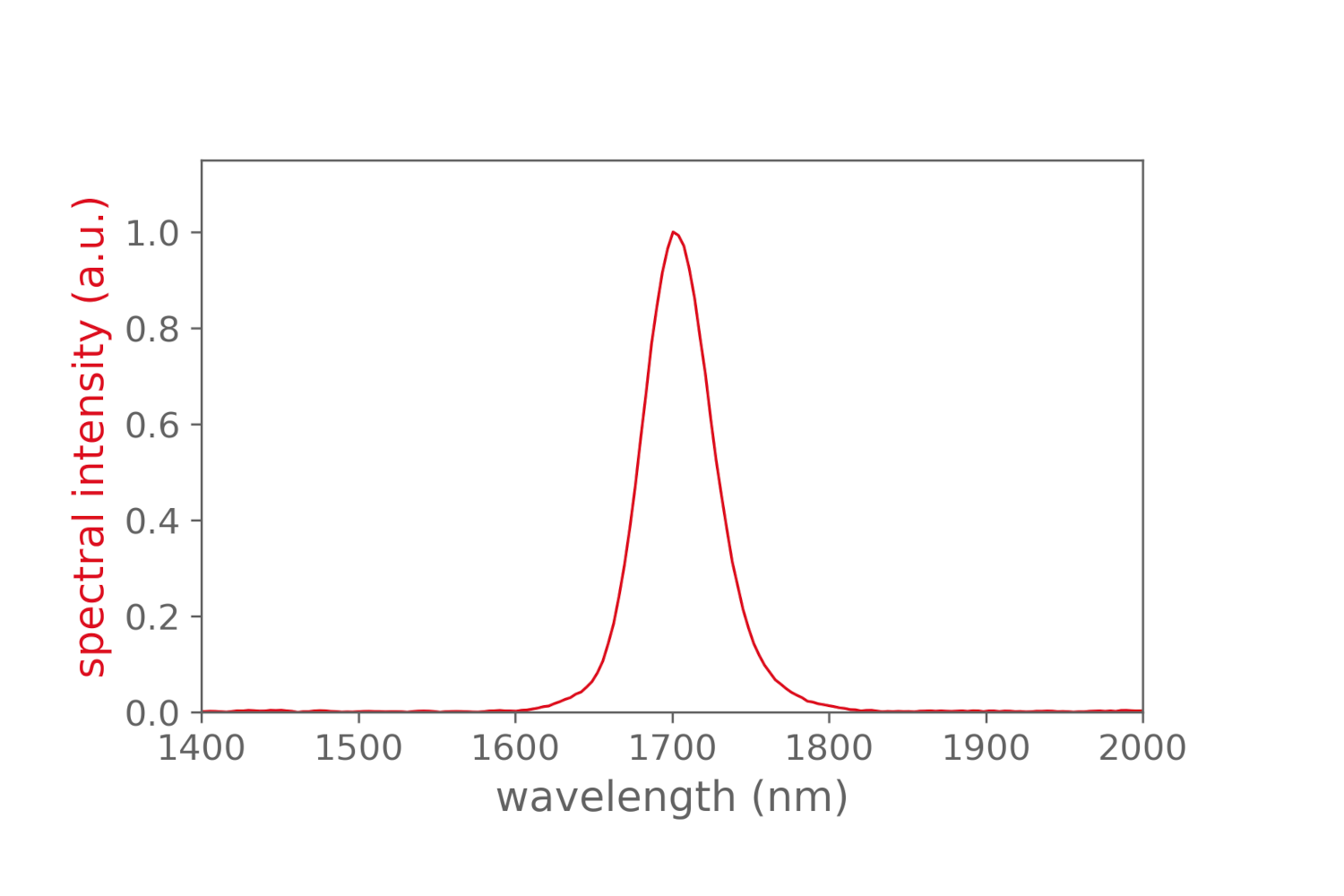
Spectrum of 1300 nm for 3-photon microscopy with GFP. Additionally, three photon action cross section spectra of GCaMP-6-f is shown (taken from https :://www janelia org/lab/harris lab/research/photophysics/two photonfluorescent probes).
Stability
Long-term power stability measured with powermeter (averaged shots) over more than 2 days.
Applications
-
Volumetric brain imaging
-
Multi-color imaging
-
Adaptive optics (AO) three-photon microscopy
FAQ
Publications
-
December 21, 2023Amr Tamimi, Martin Caldarola,…, Robert Prevedel, Deep mouse brain two-photon near-infrared fluorescence imaging using a superconducting nanowire single-photon detector array
-
September 30, 2021Streich, L., Boffi, J.C., Wang, L. et al. High-resolution structural and functional deep brain imaging using adaptive optics three-photon microscopy. Nat Methods 18, 1253–1258 (2021).
-
May 2, 2019Weisenburger et al., Volumetric Ca2+ Imaging in the Mouse Brain Using Hybrid Multiplexed Sculpted Light Microscopy, Cell (2019)


